




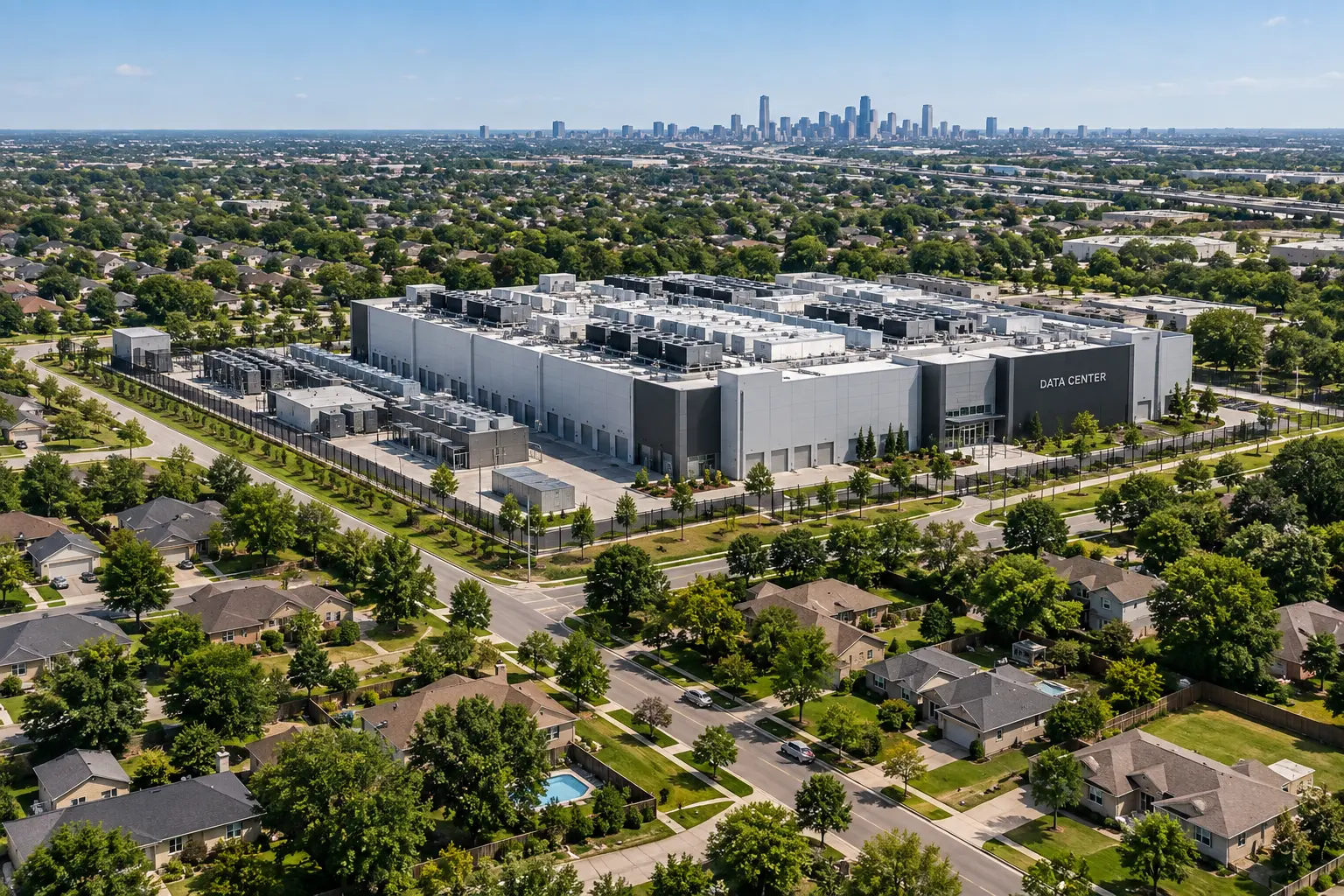
Next Door to the Machine
As AI-driven data centers spread into small towns and suburbs across the country, the people living beside them are pushing back — over water, noise, and electric bills that keep climbing.
Reporting on the local fallout of America’s data center boom · September 2026
2,500+
data centers active or under construction across the U.S.
267%
five-year electricity price increase in areas with heavy data center concentration, per a Bloomberg/Cleanview analysis
1.4%
national data center vacancy rate in H1 2026 — supply can’t keep up with demand
Drive far enough down almost any rural highway in the country this year and there’s a decent chance you’ll pass one: a windowless building the length of several football fields, ringed by chain-link fence and cooling towers, humming through the night. The AI boom has turned data centers into one of the largest waves of capital investment in American history, and the buildings are no longer confined to a handful of established hubs. They’re landing in farm towns, exurbs, and quiet subdivisions that never expected to become digital infrastructure.
For the companies building them, the pitch is straightforward: tax revenue, construction jobs, and a seat at the table of the AI economy. For a growing number of the people who live next to them, the experience has been different — persistent noise, strained water supplies, and electric bills that seem to climb every time a new facility breaks ground nearby.
The water fight nobody saw coming
Cooling is the quiet center of the conflict. Large facilities can draw millions of gallons of water a day to keep servers from overheating, and in community after community, water has become the single most common source of local objection — ahead of noise, ahead of the approval process itself, ahead of air quality concerns.
Near Detroit, the utility authority serving Ypsilanti, Michigan didn’t wait for a fight to play out project by project. In April, it approved a full year-long freeze on new water and sewer commitments for data centers, a move that stalled a facility being developed jointly by the University of Michigan and Los Alamos National Laboratory. A few miles away, in Saline, residents organized against a $16 billion data center campus being built for Oracle and OpenAI, arguing that the project’s water and power demands hadn’t been adequately weighed against the town’s own needs.
A pattern, not an outlier
Similar water-related standoffs have surfaced from Delaware to Texas. In one public comment letter filed with Delaware’s environmental regulator, a New Castle County homeowner laid out the now-familiar list of concerns about a proposed facility: a power draw potentially reaching 1.2 gigawatts, cooling systems requiring millions of gallons of water daily, and worries about what that means for groundwater and drinking supplies already relied on by neighbors.
Bills that don’t come down
Electricity is the complaint that has traveled furthest into state politics, even if it isn’t always the first thing raised at a local zoning meeting. In Virginia’s Data Center Alley — the densest concentration of server farms in the country — nearly three-quarters of voters surveyed in January said they blame nearby data centers for rising electricity costs, according to polling commissioned by the Chesapeake Climate Action Network Action Fund. That perception lines up with the broader numbers: regions with heavy data center buildout have seen electricity prices rise far faster than inflation over the past five years.
People are starting to realize these projects tend to be extractive, taking far more from a community in power, water, and land than they give back in permanent jobs or public benefit.— paraphrased from consumer advocates cited by Consumer Reports
Utility regulators are starting to respond, unevenly. In Texas, Governor Greg Abbott paused approval of new data center projects until developers pass audits verifying who’s paying for a project, how much water and electricity it will use and where that supply comes from, and what steps will be taken to limit noise and light pollution for neighbors. State lawmakers in Austin heard hours of testimony from an overflow crowd of residents this summer, many pressing the same point: home electricity bills aren’t going to fall because of the boom, only rise more slowly than they otherwise would.
Utility regulators are starting to respond, unevenly. In Texas, Governor Greg Abbott paused approval of new data center projects until developers pass audits verifying who’s paying for a project, how much water and electricity it will use and where that supply comes from, and what steps will be taken to limit noise and light pollution for neighbors. State lawmakers in Austin heard hours of testimony from an overflow crowd of residents this summer, many pressing the same point: home electricity bills aren’t going to fall because of the boom, only rise more slowly than they otherwise would.
When the industry moves to the ballot — and to court
The backlash hasn’t stayed confined to public comment periods. In Festus, Missouri, voters ousted several city council members in April after they approved a data center over resident objections. Towns across Ohio, Wisconsin, Maryland, Nevada, and California have put data center questions directly on local ballots this year, letting residents vote on construction bans, tax incentives, and zoning rules that elected officials had previously handled on their own.
Developers, in turn, have pushed back through statehouses and courtrooms. West Virginia passed a law in 2025 stripping local governments of much of their zoning and regulatory authority over data centers and the microgrids that power them; a similar bill in New Hampshire was defeated this past spring after public opposition. Where legislatures haven’t acted, some developers have gone straight to litigation — suing Saline Township in Michigan and Chatham County in North Carolina in an effort to overturn local zoning decisions that stood in the way of new projects.
Noise, oversight, and knowing who to call
Even residents who support the economic case for data centers often describe a more basic frustration: not knowing who is responsible for enforcing the rules once a facility is running. In Illinois, state regulators confirmed they hadn’t brought a single noise enforcement action against a data center in 2025, despite ongoing complaints from nearby homeowners about the low, constant hum the buildings’ cooling systems produce around the clock. State legislators there have since introduced a bill that would require data centers to publicly disclose their water and energy use, and could limit how much of that cost gets passed on to ordinary ratepayers.
In Texas, reporters have taken to publishing basic guides telling residents which of several overlapping state agencies to contact depending on the complaint — noise, water, pollution, or billing — because there’s rarely one clear answer. Advocates now recommend residents keep detailed logs: the date, time, duration, and type of noise, in case it’s ever needed as evidence.
A pause, not a resolution
None of this means the data center boom is slowing down nationally — analysts still expect hundreds of billions of dollars in new construction over the next several years, driven by demand for AI computing power that shows no sign of leveling off. What’s changed is that communities are no longer treating these projects as a foregone conclusion. Whether it’s a recall election in a small Missouri town, a water moratorium outside Detroit, or a legislative pause in Texas, the throughline is the same: residents want more say, more transparency, and more evidence that the enormous facilities going up in their backyards will actually leave their communities better off — not just their power bills higher and their water tables lower.
Compiled from public reporting, state hearing records, utility filings, and public comment letters, including coverage from The Conversation, CBS Texas, Consumer Reports, KPRC Click2Houston, and Illinois broadcast affiliates, current as of September 2026.