


Smart Rings: The Complete Guide to Smart Ring Technology, Features, Benefits and Buying Tips
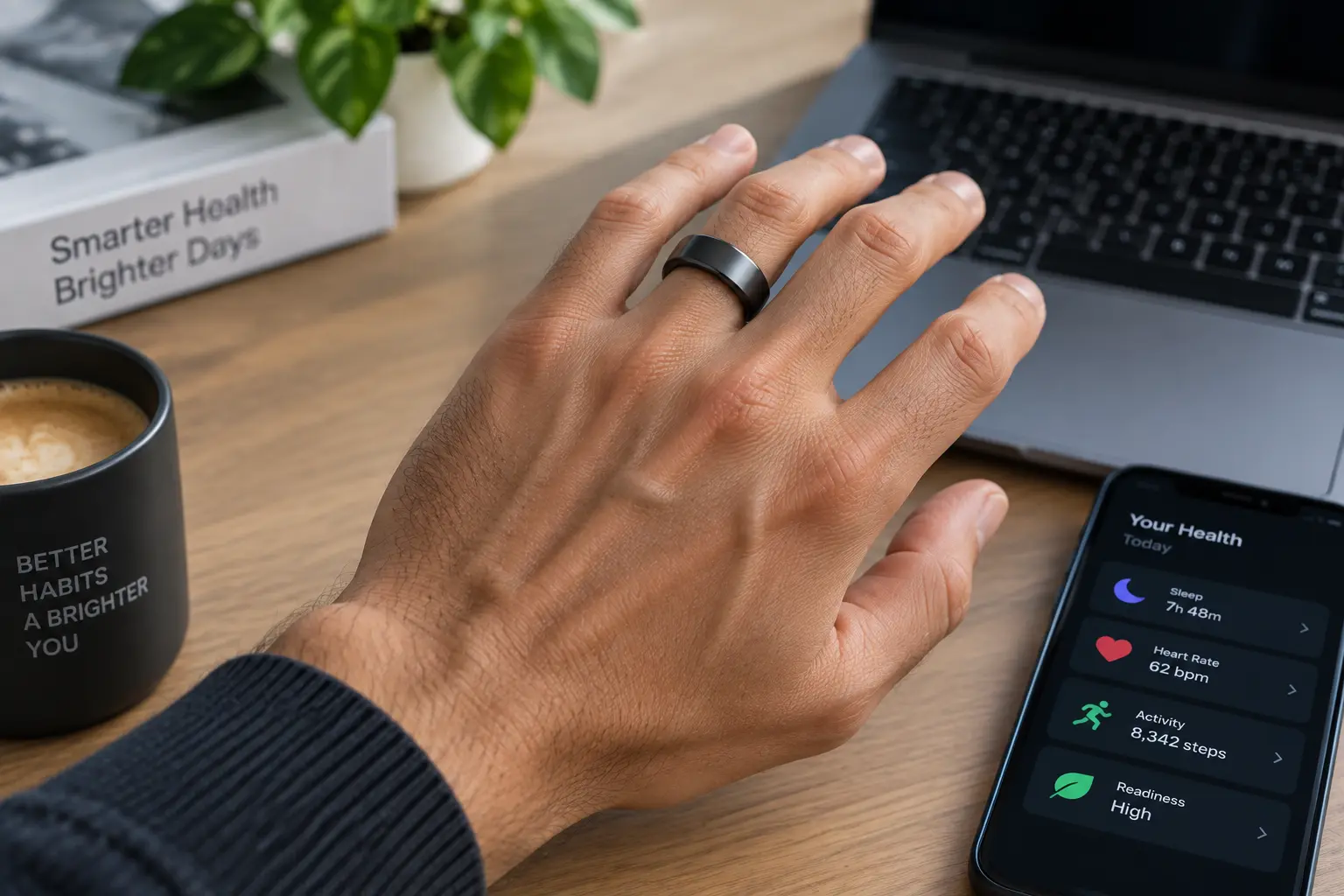
Smart rings are small wearable devices designed to be worn on a finger while collecting information about movement, sleep and various physiological signals. Depending on the model, a smart ring can track metrics such as heart rate, heart-rate variability (HRV), blood oxygen, skin or body-temperature trends, activity, sleep and recovery.
Unlike smartwatches, most smart rings do not have a display. Instead, they collect data and send it to a smartphone app, where software processes the information into measurements, trends, scores and recommendations.
The category has expanded beyond basic activity tracking. Products from companies such as Oura, Samsung, Ultrahuman and RingConn combine optical sensors, temperature sensors and motion sensors with software designed to provide health, fitness and wellness insights.
What Is a Smart Ring?
A smart ring is a finger-worn electronic device that contains sensors, processing hardware, a rechargeable battery and wireless connectivity. Its sensors collect physiological or movement signals, and software converts those signals into measurements or estimates displayed in a companion app.
In simple terms:
Smart ring = sensors + electronics + algorithms + smartphone app
Most consumer smart rings are designed primarily for health, wellness, fitness and sleep tracking rather than as replacements for smartphones or smartwatches.
How Does a Smart Ring Work?
A typical smart ring works through several stages:
- Sensors collect physiological or movement signals.
- The ring’s electronics process or temporarily store the data.
- Data is transferred to a smartphone, generally through Bluetooth.
- The companion app analyzes the information.
- Algorithms combine multiple signals to produce metrics, trends or scores.
- The user views the results through the app.
Oura Ring 4, for example, uses optical sensors for heart-rate and blood-oxygen measurements, a digital temperature sensor and an accelerometer for movement. Samsung’s Galaxy Ring uses an optical bio-signal sensor, skin-temperature sensor and accelerometer. (Oura; Samsung)
A smart ring does not directly measure concepts such as “sleep quality” or “recovery.” Instead, software derives those insights from the underlying sensor signals.
Smart Ring Sensors and Technology
The hardware inside a smart ring is constrained by its size. Manufacturers have to fit sensors, electronics, a battery and wireless components into a device that remains comfortable enough for continuous wear.
Photoplethysmography (PPG)
Photoplethysmography, or PPG, is an optical sensing technique widely used in wearable devices.
PPG uses light and a photodetector to measure changes associated with blood volume in tissue. Those changes can be analyzed to estimate pulse-related measurements such as heart rate.
Research on wearable PPG describes it as an optical method for measuring the arterial pulse and notes its use across consumer wearables. (PMC)
The finger is particularly useful for optical sensing, making PPG an important technology for smart rings.
Oura Ring 4, for example, uses green and infrared LEDs for heart-rate and HRV measurements and red and infrared LEDs for blood-oxygen sensing. (Oura)
Accelerometers
Accelerometers detect changes in movement and acceleration.
In a smart ring, accelerometer data can contribute to:
- Step counting
- Activity detection
- Movement analysis
- Sleep-related movement detection
- Workout detection on supported devices
Samsung lists an accelerometer among Galaxy Ring’s primary sensors, while Oura also uses an accelerometer for movement and activity tracking. (Samsung; Oura)
Temperature Sensors
Temperature sensors can detect changes in skin or peripheral temperature.
Rather than being treated simply as a one-time temperature reading, these measurements can be used as part of longer-term analysis. Depending on the product, temperature trends may contribute to sleep, recovery, wellness or menstrual-cycle-related insights.
Samsung Galaxy Ring and Oura Ring 4 both include temperature sensing.
Blood-Oxygen Sensors
Some smart rings use optical sensing to estimate blood oxygen saturation, commonly represented as SpO2.
Oura says its red and infrared LEDs are used for blood-oxygen sensing during sleep. RingConn also lists blood-oxygen tracking among the functions of its Gen 2 ring. (Oura; RingConn)
These readings should not automatically be treated as medical measurements. The purpose, validation and regulatory status depend on the product and its intended use.
Other Sensors and Research Technologies
Research into finger-worn devices has explored additional sensing technologies, including ECG and galvanic skin response.
One published smart-ring-like biomedical system demonstrated simultaneous acquisition of ECG, PPG, galvanic skin response and motion signals. (PMC)
However, a sensor demonstrated in research does not mean that the same technology is included in every commercially available smart ring.
What Can a Smart Ring Track?
The exact capabilities differ between products, but common smart-ring measurements and derived insights include:
- Heart rate
- Heart-rate variability
- Blood oxygen
- Temperature trends
- Respiratory rate
- Steps and activity
- Sleep duration
- Sleep stages or sleep-related estimates
- Stress-related trends
- Recovery or readiness
- Workout data
- Menstrual-cycle-related information
Not every ring supports every metric, and two products may use different sensors and algorithms to produce similar measurements.
Heart Rate
Heart rate is one of the most common smart-ring measurements.
Optical sensors such as PPG are used to estimate pulse rate. Smart rings may collect heart-rate data at different intervals depending on the product and feature.
The value of heart-rate data is often greater when looking at trends over time rather than a single isolated reading.
Heart-Rate Variability
Heart-rate variability (HRV) describes variation in the intervals between heartbeats.
Smart rings can derive HRV from optical heart-rate measurements, particularly during periods of relatively low movement or sleep.
Oura, for example, lists HRV among the metrics derived from its optical sensing system.
HRV naturally varies between individuals, so it is generally more useful to compare changes against a person’s own baseline than to treat one number as universally “good” or “bad.”
Sleep
Smart rings can use a combination of movement, heart rate, HRV, temperature and other measurements to estimate sleep-related metrics.
Depending on the product, the app may report:
- Total sleep duration
- Sleep timing
- Sleep stages
- Sleep efficiency
- Time awake
- Resting heart rate
- Overnight HRV
- Temperature trends
- Respiratory measurements
- Sleep scores or summaries
Sleep tracking is one of the most established use cases for smart rings because the form factor is relatively unobtrusive during the night.
Activity and Movement
Motion sensors allow smart rings to monitor activity and movement.
Depending on the model, this can include:
- Steps
- Activity duration
- Movement intensity
- Automatically detected activities
- Workout sessions
Stress, Recovery and Readiness
Some smart-ring platforms combine several measurements to provide higher-level insights such as stress, recovery or readiness.
These are derived metrics, not direct sensor readings.
For example, Oura calculates Readiness and Stress-related insights from combinations of physiological and behavioral data, while Samsung’s Energy Score combines measurements including sleep, activity, sleeping heart rate and sleeping HRV.
Smart Ring Features
Beyond the underlying sensors, smart rings differ in the software and features built around that hardware.
Health and Wellness Monitoring
Common features include heart rate, HRV, temperature, blood oxygen, activity and sleep tracking.
The exact combination depends on the model.
Sleep Tracking
Sleep tracking is a major focus of many smart rings. Some products provide detailed sleep reports and overnight trends, while others concentrate on simpler summaries.
Fitness Tracking
Smart rings can track daily activity and, on supported models, workouts. They are generally less suited than sports-focused smartwatches to displaying live workout information.
Women’s Health
Some manufacturers use temperature trends and other physiological measurements for menstrual-cycle-related features.
These functions vary by product and should not automatically be treated as equivalent to clinical fertility monitoring.
Notifications and Smart Functions
Unlike smartwatches, most health-focused smart rings have no conventional display and therefore do not provide the same notification and app experience.
Some rings in the broader category may offer NFC, authentication or device-control functions, but these are not universal.
Smart Ring vs Smartwatch vs Fitness Tracker
The categories overlap, but their primary strengths are different.
| Feature | Smart Ring | Smartwatch | Fitness Tracker |
|---|---|---|---|
| Sleep tracking | Common | Common | Common |
| Heart-rate tracking | Common | Common | Common |
| HRV | Common on health-focused models | Common on many models | Model-dependent |
| Temperature tracking | Common on health-focused models | Model-dependent | Model-dependent |
| Display | Usually none | Yes | Usually yes |
| Notifications | Usually limited or none | Extensive | Usually available |
| Live workout controls | Limited | Strong | Moderate |
| Built-in GPS | Uncommon | Common on many models | Model-dependent |
| Battery life | Often several days | Often one or several days | Often several days |
| Sleep comfort | Often a major advantage | Depends on user | Depends on design |
| Primary strength | Passive health and wellness tracking | Health, fitness and smart-device functions | Activity and fitness tracking |
Which Is Better: Smart Ring or Smartwatch?
The answer depends on what the user needs.
A smart ring is designed primarily for discreet, passive data collection. A smartwatch is more versatile for users who want a screen, notifications, live workout metrics, apps and GPS.
Some people may reasonably use both devices, particularly when the ring is used for continuous sleep and wellness tracking and the watch is used during workouts and throughout the day.
Are Smart Rings Accurate?
Accuracy is one of the most important factors when evaluating a smart ring.
It depends on:
- The sensor technology
- The algorithm
- The specific measurement
- How the ring fits
- Movement
- The user’s physiology
- The reference method used for validation
- The particular device generation
It is therefore misleading to describe all smart rings as simply “accurate” or “inaccurate.”
Heart Rate and HRV Accuracy
Research has evaluated Oura’s overnight heart-rate and HRV measurements against ECG-based reference measurements.
One peer-reviewed study involving 35 healthy participants found strong agreement for the nocturnal measurements examined. (PMC)
A broader 2025 systematic review of smart rings in clinical medicine also found promising results for some heart-rate and HRV applications while noting differences in validation quality between devices and use cases. (PubMed)
Sleep Accuracy
A 2025 systematic review and meta-analysis compared Oura Ring against polysomnography or actigraphy across six studies involving 388 participants.
The review found no statistically significant differences for several commonly measured sleep parameters, including total sleep time and sleep efficiency. (PubMed)
This does not mean that every smart ring produces clinical-grade sleep measurements.
Polysomnography records multiple physiological signals in a controlled clinical setting, while a consumer ring estimates sleep using a smaller set of sensors and algorithms.
What Can Affect Accuracy?
Fit is important because the optical sensors need reliable contact with the skin.
Oura, for example, recommends that its ring fit securely and that the sensor area face the palm side of the finger. (Oura)
Movement can also affect optical measurements. Motion artifacts are a known challenge in wearable PPG systems. (PMC)
This is one reason measurements taken during sleep or rest can behave differently from measurements collected during vigorous movement.
Smart Rings for Sleep and Fitness
Why Smart Rings Are Popular for Sleep Tracking
The ring form factor has a practical advantage at night: it is smaller and does not have a bright display or large watch body.
A 2025 meta-analysis found evidence supporting Oura’s ability to measure several common sleep parameters, although consumer rings remain different from clinical sleep-study equipment. (PubMed)
Smart Rings for Fitness
Smart rings can monitor activity and some workouts, but their functionality is different from a sports watch.
For users who need:
- Live pace
- Continuous workout-screen information
- GPS maps
- Detailed training controls
- Large on-device displays
a smartwatch can be more suitable.
Do Smart Rings Have GPS?
Most health-focused smart rings do not contain standalone GPS hardware.
Some instead rely on the connected smartphone for location data.
Ultrahuman, for example, lists Ring AIR without built-in GPS. (Ultrahuman)
Can You Wear a Smart Ring While Exercising?
Many smart rings are designed to be worn during exercise, but users should follow the manufacturer’s guidance.
Water resistance also varies between products. For example, Oura Ring 4 is rated to 100 meters, while Samsung Galaxy Ring carries 10 ATM and IP68 ratings. (Oura; Samsung)
Smart Rings, AI and Health Insights
AI and machine learning are becoming increasingly important in wearable technology.
The ring itself may only collect relatively simple signals, such as movement, heart rate and temperature. The software layer can then combine those measurements with historical data to identify patterns.
For example:
Heart rate + HRV + sleep + activity + temperature + historical baseline
can produce a higher-level interpretation that would be difficult to obtain from any single measurement.
How AI Can Be Used
AI and machine-learning systems can potentially help with:
- Pattern detection
- Trend analysis
- Personalized recommendations
- Natural-language summaries
- Contextual insights
- Combining multiple data sources
- Identifying deviations from an individual’s baseline
Oura describes AI and machine-learning-based services within its platform, while Samsung uses Galaxy AI as part of the Galaxy Ring and Samsung Health ecosystem.
However, an AI-generated health or wellness insight should not automatically be interpreted as medical advice.
Can Smart Rings Detect Health Problems?
A smart ring can identify changes or patterns in physiological measurements, but that does not mean that it can diagnose a medical condition.
A user may notice changes such as:
- Higher resting heart rate
- Changes in HRV
- Altered sleep patterns
- Temperature changes
- Changes in blood-oxygen readings
- Reduced activity
These observations can be useful for personal awareness, but they do not establish a diagnosis on their own.
The U.S. Food and Drug Administration’s guidance on general-wellness products distinguishes low-risk wellness functions from products intended for medical purposes such as diagnosing or treating disease. (FDA)
Samsung likewise states that Galaxy Ring and Samsung Health features are intended for general wellness and fitness rather than diagnosis or treatment.
Are Smart Rings Medical Devices?
Not necessarily.
Whether a specific product or feature is considered a medical device depends on its intended use, claims and applicable regulations.
Consumers should distinguish between wellness tracking and medical monitoring and should not assume that a consumer wearable provides medically validated diagnosis simply because it reports a physiological measurement.
Smart Ring Privacy and Data Security
A smart ring can collect highly personal information, particularly when it is worn continuously.
Potentially sensitive data can include:
- Heart rate
- Sleep
- Movement
- Temperature
- Activity
- Reproductive-health-related information
- Account information
- Data generated from connected services
Oura’s privacy documentation, for example, describes the processing of measured data and calculated health and wellness information.
Samsung also publishes a consumer-health-data privacy statement covering health information collected through its services.
What Should You Check?
Before purchasing a smart ring, review:
- What data is collected
- Where it is stored
- Whether cloud storage is used
- What third parties receive data
- Which integrations are supported
- Whether data can be exported
- How data can be deleted
- How permissions are managed
- How AI features use personal data
Privacy policies can change, so the manufacturer’s current policy should always take precedence over information published in older reviews.
Smart Ring Battery Life and Durability
Battery life varies significantly between models.
| Smart Ring | Manufacturer-stated battery life* |
|---|---|
| Oura Ring 4 | 5–8 days |
| Samsung Galaxy Ring | Up to 7 days |
| Ultrahuman Ring AIR | 4–6 days |
| RingConn Gen 2 | 10–12 days |
*These are manufacturer claims, not standardized independent test results. Actual battery life depends on size, settings, features and usage. (Oura; Samsung; Ultrahuman; RingConn)
Water Resistance
Many current smart rings are designed for continuous wear and have water-resistance ratings.
Examples include:
- Oura Ring 4: up to 100 meters
- Samsung Galaxy Ring: 10 ATM and IP68
- Ultrahuman Ring AIR: up to 100 meters according to the manufacturer
- RingConn Gen 2: IP68 and manufacturer-stated water resistance
The ratings are not identical standards and should be interpreted according to the manufacturer’s usage guidelines.
“Water resistant” also does not mean that every ring is suitable for every underwater activity.
Smart Ring Sizing and Comfort
Sizing is particularly important because sensor performance depends partly on the quality of skin contact.
A ring that is too loose can shift position, while one that is too tight can become uncomfortable as finger size naturally changes.
Manufacturers commonly provide dedicated sizing kits because smart-ring sizing does not necessarily correspond to standard jewelry-ring sizes.
Oura recommends using its sizing process and positioning the sensors toward the palm side of the finger. RingConn likewise states that its sizes differ from conventional rings and other smart-ring brands.
Which Finger Should You Wear a Smart Ring On?
The ideal finger varies by manufacturer and product.
The important factors are a secure fit, comfort and correct sensor positioning.
The manufacturer’s instructions should take priority over generic advice.
Do Smart Rings Require a Subscription?
This is one of the biggest differences between products.
Some companies charge a recurring subscription for advanced insights, while others market their core experience without a mandatory subscription.
Oura Ring
Oura’s current membership provides the full set of features and insights. Without an active membership, the available information is substantially more limited.
Samsung Galaxy Ring
Samsung states that Galaxy Ring integrates with Samsung Health without a subscription for its core experience, although specific features can have device, account, software or regional requirements.
Ultrahuman Ring AIR
Ultrahuman advertises Ring AIR without a mandatory recurring subscription.
RingConn Gen 2
RingConn advertises Gen 2 without subscription fees for its core health-monitoring experience.
Because pricing and services can change, buyers should verify the current subscription policy before purchasing.
Popular Smart Ring Brands and Models
Oura Ring 4
Oura Ring 4 is focused on sleep, activity, heart-related measurements, temperature trends and other wellness insights.
Its sensor system includes optical sensors, a temperature sensor and an accelerometer. Oura lists battery life of approximately five to eight days depending on size and usage.
Samsung Galaxy Ring
Galaxy Ring combines an optical bio-signal sensor, skin-temperature sensor and accelerometer.
Samsung integrates the ring with Samsung Health and uses multiple measurements for features such as Sleep Analysis and Energy Score.
Ultrahuman Ring AIR
Ultrahuman positions Ring AIR around health, sleep, activity and recovery tracking.
The company advertises four-to-six-day battery life and no mandatory subscription.
RingConn Gen 2
RingConn Gen 2 focuses on health and sleep tracking and advertises 10–12 days of battery life.
The company lists measurements and insights covering sleep, stress, heart rate, HRV, blood oxygen, activity and women’s health.
These products should not be treated as a ranking. Features, software, pricing and availability can change over time.
How to Choose the Right Smart Ring
The right product depends on the user’s priorities rather than the number of specifications on the box.
Health Features
Identify the metrics you actually need, such as sleep, heart rate, temperature or activity.
Accuracy and Validation
Look for independent testing and peer-reviewed research where available. Manufacturer specifications and independent validation are different types of evidence.
Battery Life
Compare the manufacturer’s stated battery life, but remember that real-world results vary.
Comfort and Sizing
A smart ring is generally intended to be worn for long periods, making comfort one of the most important practical considerations.
Compatibility
Check smartphone and operating-system compatibility. Some features may work only within a particular ecosystem.
App Quality
The mobile app is effectively the user interface for most smart rings.
Look at:
- Data visualization
- Trend analysis
- Reports
- Integrations
- Export capabilities
- Ease of use
Subscription Cost
Calculate the total cost over the period you expect to own the device.
Privacy
Read the privacy policy and understand what happens to your health data.
Warranty and Support
Check warranty coverage, returns, replacement policies and regional customer support.
Smart Ring Buying Checklist
Before purchasing a smart ring, check:
- Correct size and sizing process
- Smartphone compatibility
- Sensors and supported measurements
- Sleep-tracking capabilities
- Activity and workout support
- Battery life
- Charging system
- Water-resistance rating
- Subscription requirements
- App functionality
- Privacy practices
- Data export options
- Warranty
- Replacement policy
- Total cost of ownership
The most useful ring is not necessarily the one with the longest feature list. It is the one whose measurements, software and ownership model match the user’s actual needs.
Common Smart Ring Limitations
Smart rings have several inherent limitations.
No or Limited Display
Most health-focused rings require a smartphone app to view detailed information.
Small Battery
The small form factor limits battery capacity, even though many rings can last several days.
Sizing Challenges
A poor fit can affect comfort and potentially sensor contact.
Motion Artifacts
Movement can interfere with optical measurements.
Smartphone Dependence
The companion app is central to setup, synchronization and analysis.
Subscription Costs
Some products require recurring payments to access their full software experience.
Limited Workout Functionality
A ring is generally not designed to replace a dedicated sports watch for live training data.
Wellness Does Not Equal Diagnosis
Consumer health metrics should not automatically be treated as medical diagnoses.
Privacy Considerations
Continuous health tracking generates sensitive information that users should understand before committing to a platform.
How to Set Up and Use a Smart Ring
Although the exact process varies between manufacturers, the general setup is similar.
1. Choose the Correct Size
Use the manufacturer’s sizing system or sizing kit.
2. Charge the Ring
Charge the device according to the manufacturer’s instructions.
3. Install the Companion App
Download the official application for your smartphone.
4. Create or Sign In to an Account
Some products require an account for data synchronization and software features.
5. Pair the Ring
Follow the manufacturer’s Bluetooth-pairing process.
6. Configure Permissions
Review permissions related to health data, location and connected services.
7. Wear the Ring Correctly
Follow the manufacturer’s positioning instructions.
8. Use It Consistently
Many smart-ring insights become more useful after the system has collected enough historical data to establish a personal baseline.
How to Clean and Maintain a Smart Ring
Cleaning procedures depend on the manufacturer’s materials and recommendations.
In general:
- Keep the ring clean
- Dry it according to manufacturer instructions after exposure to water
- Avoid chemicals that are not approved for the device
- Keep charging contacts and accessories clean
- Inspect the ring for damage
- Follow manufacturer battery-care guidance
- Remove the ring during activities that could damage it
Water resistance can also change over time as seals and materials age.
Smart Ring FAQs
What is a smart ring?
A smart ring is a finger-worn electronic device that uses sensors and software to collect and analyze information such as movement, sleep, heart rate and other physiological signals.
How does a smart ring work?
Sensors collect physiological and movement data, which is processed by the ring and/or companion software and displayed through a smartphone app.
What does a smart ring measure?
Depending on the model, it can measure or estimate heart rate, HRV, blood oxygen, temperature trends, movement, activity, sleep and other wellness metrics.
Are smart rings accurate?
Accuracy varies by device and measurement. Published research supports the usefulness of some smart rings for specific measurements, but findings for one device should not automatically be generalized to every product.
Can smart rings track sleep?
Yes. Sleep tracking is one of the main uses of current smart rings.
Can smart rings track heart rate?
Yes. Many smart rings use optical PPG sensors to estimate heart rate.
Can smart rings measure blood oxygen?
Some models can estimate blood oxygen using optical sensors.
Many health-focused smart rings include temperature sensors and use temperature trends in wellness-related analysis.
Can smart rings measure temperature?
Do smart rings have GPS?
Most health-focused smart rings do not contain standalone GPS hardware. Some can use a connected smartphone for location information.
Do smart rings need a phone?
Smart rings generally rely on a companion app for setup, synchronization and detailed analysis, although some models can store data temporarily before syncing.
For example, RingConn says Gen 2 can store up to seven days of data offline. (RingConn)
Do smart rings require a subscription?
Some do and some do not.
Oura requires membership for its full software experience, while Samsung, Ultrahuman Ring AIR and RingConn Gen 2 currently advertise core experiences without mandatory recurring subscriptions.
Can you sleep with a smart ring?
Yes. Sleep tracking is one of the main reasons people choose smart rings.
Are smart rings waterproof?
Many are water resistant, but ratings vary. Check the specific manufacturer’s rating and usage instructions.
Which finger should you wear a smart ring on?
Follow the manufacturer’s recommendations. A secure and comfortable fit with correct sensor positioning is more important than a universal finger recommendation.
Can smart rings replace smartwatches?
For passive health and sleep tracking, they can for some users. They generally cannot replace smartwatch features such as large-screen interaction, notifications, live workout controls and built-in GPS.
Are smart rings medical devices?
Not necessarily. Classification depends on the product’s intended use, claims and applicable regulations.
Can smart rings diagnose health conditions?
Consumer wellness rings should not be assumed to diagnose health conditions. Concerning symptoms or measurements should be evaluated by an appropriate healthcare professional.
Are smart rings worth buying?
Their usefulness depends on the individual.
They can be particularly appealing to people who value passive health monitoring, sleep tracking, small size and long-term wellness trends. Users who prioritize a display, notifications, GPS and advanced workout features may prefer a smartwatch.
The Future of Smart Rings
Smart rings are evolving from relatively simple activity trackers into broader health and wellness platforms.
The next stage of the category is likely to involve both better sensing and better interpretation.
The basic progression is:
More sensing → better algorithms → stronger personal baselines → more useful insights
AI could make large amounts of wearable data easier to understand by turning measurements and trends into natural-language summaries and personalized recommendations.
Research is also exploring increasingly sophisticated finger-worn sensing systems. Published work has demonstrated combinations of PPG, ECG, motion and galvanic skin-response sensing, while systematic reviews continue to examine the potential clinical applications of smart rings.
At the same time, three areas will remain important as the category develops:
Measurement quality: Sensors and algorithms need meaningful validation.
Privacy: Wearables collect increasingly detailed personal information.
Regulation: Health-related claims need to be distinguished from general wellness functionality.
The future of smart rings will therefore depend not only on making sensors smaller, but on making the resulting data more reliable, understandable and useful.
Conclusion
A smart ring is a compact wearable computer designed primarily for passive health, fitness and wellness tracking.
Modern products can monitor or estimate measurements such as heart rate, HRV, temperature, movement, sleep and, on some devices, blood oxygen. Software then combines those signals to produce higher-level information about sleep, recovery, activity and wellness.
The technology has clear advantages. Smart rings are small, discreet and well suited to continuous wear, particularly during sleep. They can also provide useful long-term trends without requiring users to constantly look at a screen.
They also have limitations. Accuracy varies by device and measurement, some products use subscription models, sizing and sensor contact matter, and consumer wellness measurements should not automatically be interpreted as medical diagnoses.
Choosing a smart ring is therefore less about finding the device with the largest number of features and more about finding the right combination of sensors, validated measurements, comfort, battery life, software, compatibility, privacy and total ownership cost.
As the technology develops, AI and increasingly sophisticated sensor systems may make smart rings more useful as personal health and wellness platforms. The quality of those insights, however, will depend on the quality of the underlying measurements and the evidence supporting them.