Google Tests New Ads in AI Mode, Including for Users Who Connect Their Apps
Key points
- Google says it is testing new Gemini-powered ad formats built into AI Mode responses. Its examples show three: Direct Offers, Conversational Discovery and Highlighted Answers.
- Per Search Engine Land and Search Engine Roundtable, Google has also begun testing ads for users who connect apps through Personal Intelligence, which was previously ad-free.
- Google says ads won’t be based directly on Gmail or Google Photos content, and that advertisers can’t access connected apps.
- The announcement material we reviewed doesn’t give rollout timing, markets or advertiser eligibility.
Google is moving ads deeper into AI Mode. The company’s advertiser announcement says it is testing new formats inside AI-generated answers, and trade reports say ads are now being tested for people who have connected their apps through Personal Intelligence.
What Google says about the new formats
Google’s announcement opens with a pitch: “your brand doesn’t just show up – it answers.” It describes a new generation of formats, under a “New for 2026” heading, designed to move users from discovery to decisions. Google says the formats are more visual, able to reason, and integrated directly into AI-generated responses while remaining clearly labeled as ads.
The announcement highlights three benefits:
- Built-in relevance. The formats sit inside AI responses and are meant to stay relevant to the user’s search.
- Ads that reason. Google says the formats are powered by AI Max and Performance Max, and that they adapt their creative and explain why a product is a good answer to the question asked.
- Conversations that convert. Google says the ads show verified product details to help users decide faster.
Google’s accompanying image shows three formats, with an example of each:
- Direct Offers: A retailer deal, shown as a limited-time saving on a bundled bedding purchase, with product prices, ratings and a purchase button.
- Conversational Discovery: A branded product suggestion placed inside an answer to a home-scent query.
- Highlighted Answers: A linked brand entry placed inside an answer about learning a language.
Each example carries a “Sponsored” label, and the screens include a note that AI responses are generated independently. The brands in the images appear in Google’s illustrative screens, so they shouldn’t be read as confirmed live advertisers.
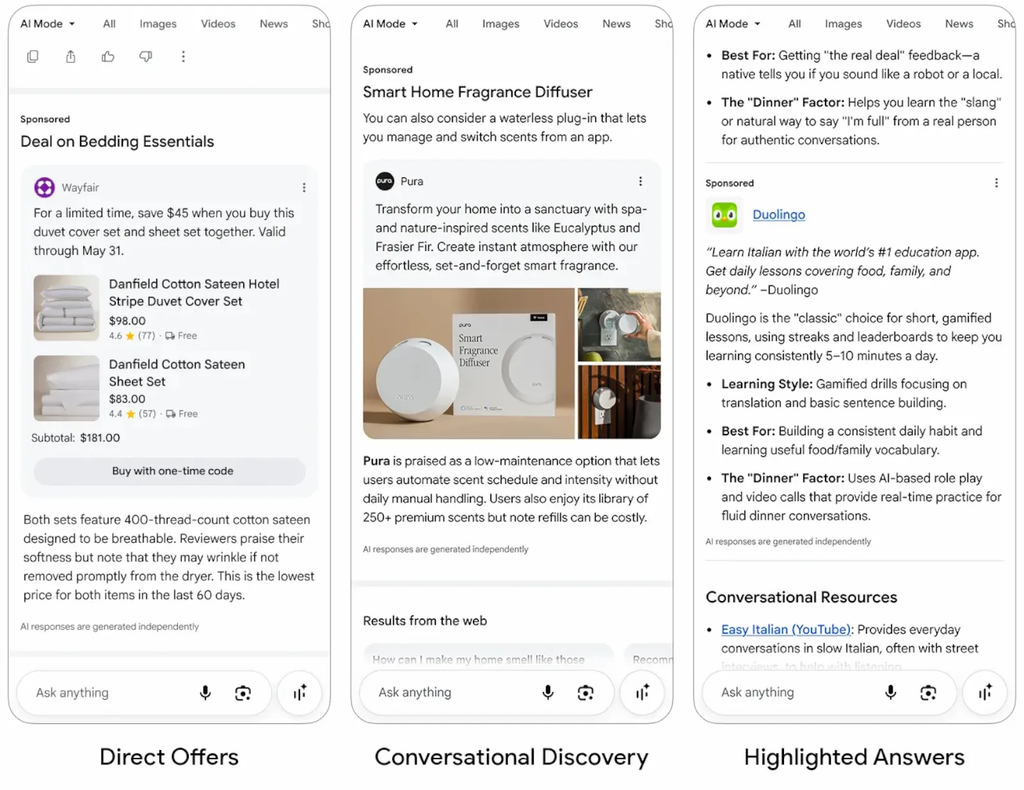
Image source: Google
The Personal Intelligence test
Search Engine Land reported on October 16, 2026 that Google confirmed it is starting to test ads in AI Mode for users who connect their apps through Personal Intelligence. The outlet described this as a reversal of the earlier ad-free approach. Search Engine Roundtable followed on October 19, noting that ads in AI Mode aren’t new, but ads alongside Personal Intelligence are.
When Personal Intelligence reached AI Mode, Google told Search Engine Land that connected users had no ads. Search Engine Roundtable reports Google added that it anticipated ads would work similarly later. Under the test, information AI Mode draws from connected apps, such as insights and summaries, may also help determine which ads a user sees.
Privacy limits Google describes
According to Search Engine Land and Google’s updated help page, as quoted by Search Engine Roundtable:
- Users must opt in to connect apps and can disconnect at any time.
- Ads won’t be based directly on a user’s Gmail inbox or Google Photos library.
- Advertisers can’t access connected apps.
- Google says it doesn’t show personalized ads based on sensitive categories such as race, religion, sexual orientation or health.
The help page also says Search may reference summaries, excerpts and inferences from connected sources, and that this information may be used for ads. Search Engine Roundtable says the previous version of the page lacked this language. Search Engine Land adds that Google updated its privacy policy.
What isn’t clear
The sources don’t establish whether the formats in Google’s announcement and the Personal Intelligence test are the same initiative. Neither Google’s announcement text nor its images mention Personal Intelligence, connected apps or personalization, and the trade reports don’t describe the formats. TechX.press has not assumed a link between the two.
Also unconfirmed: the countries and share of users involved, how long testing will run, whether Personal Intelligence eligibility has changed since launch, and what advertisers must do to participate. Search Engine Land notes that Google hasn’t announced new advertiser controls, targeting options or a broader rollout for the Personal Intelligence test.
Why it matters
For users, ads are moving from beside the answer to inside it, in the part of Search where people expect a direct, synthesized response. Google’s commitment to labeling the ads is therefore central. For advertisers, Google’s pitch is that the ads can explain why a product fits a question, which is a different job from a traditional text ad. For the wider search ecosystem, the Personal Intelligence test shows ads reaching an experience that launched without them.
Techx.press perspective
The format announcement and the Personal Intelligence test are easier to defend separately than together. Ads that reason, show verified details and are clearly labeled can be useful on a shopping query, and the labeling commitment is the right one.
The labeling question gets more concrete in Google’s mockups. The “Sponsored” tag is visible in each example, but in Highlighted Answers the ad sits inside the flow of the response, between answer-style content and a resources section. A user skimming could plausibly read it as part of the answer. The “generated independently” note appears to be a general disclaimer, not an ad-specific one, so it doesn’t settle the matter. How prominent the label is in the live product will matter more than how it looks in a promotional image.
The Personal Intelligence piece raises a trust question more than a technical one. Google’s earlier statement was careful (“right now”), so the reversal isn’t a contradiction, but users who connected apps expecting no ads may reasonably feel the terms shifted. The “not directly based on Gmail or Photos” line is a real limit, yet the same help page allows summaries, excerpts and inferences from those apps to feed ads. In Google’s favor, the opt-in, easy disconnection and lack of advertiser access are meaningful controls, and ads funding Search is hardly a surprise.
We’d watch for three things: how ads are labeled inside personalized answers, whether users can see why they got a given ad, and whether advertiser controls follow.