




Image credit – Apple
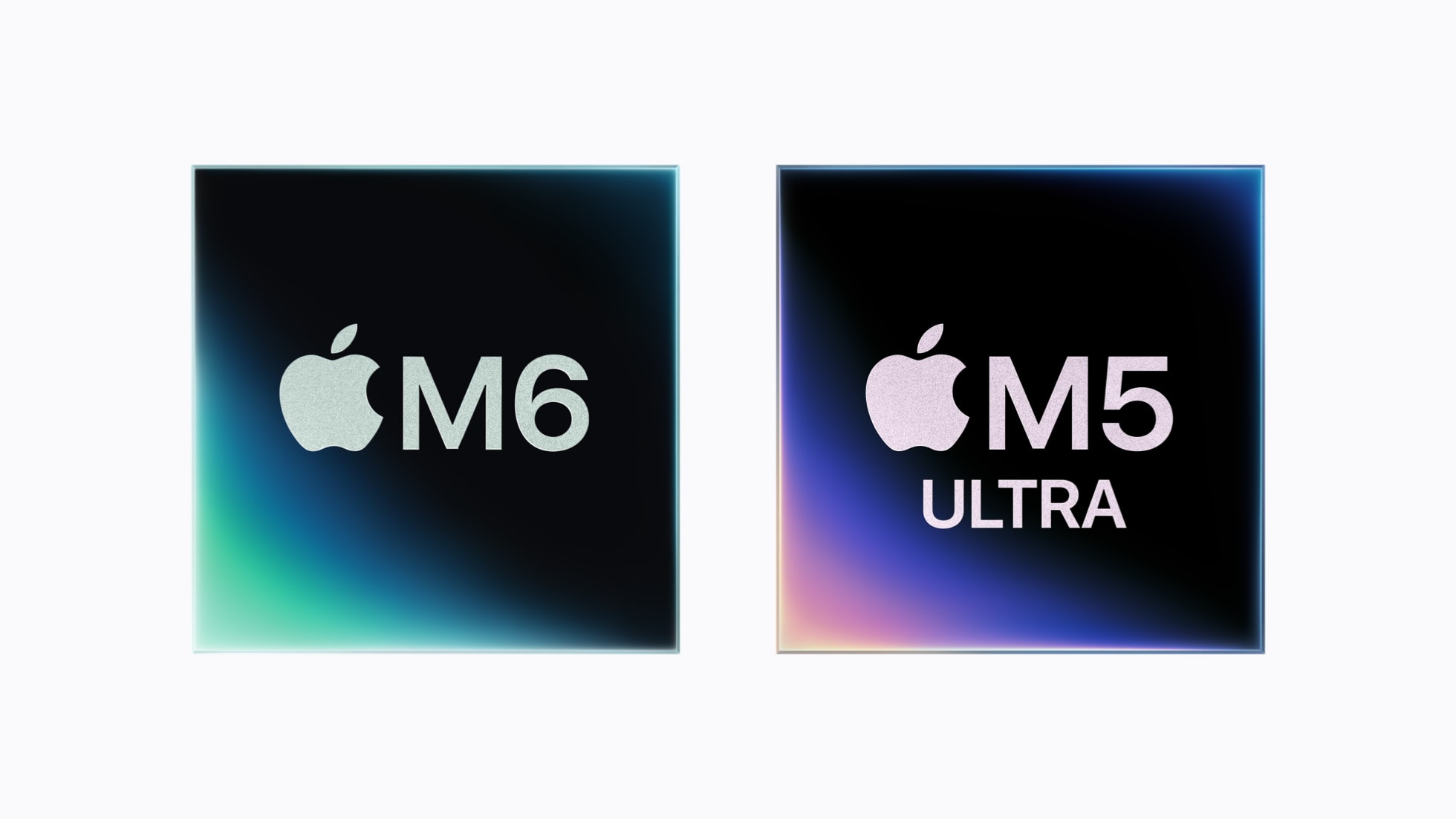
In a surprise late-August announcement, Apple has introduced two new additions to its Apple Silicon lineup: the M6 and the M5 Ultra. The chips arrive inside a refreshed Mac mini and a redesigned Mac Studio, respectively, both available for pre-order now, with shipments beginning September 22 running macOS 27 “Golden Gate.”
M6: A New Process Node, A New Core Architecture
The M6 marks a milestone for Apple — it’s the company’s first chip built on a 2-nanometer manufacturing process, a shift that boosts transistor density and improves power efficiency without growing the chip’s physical size.
Beyond the process shrink, the M6 introduces a more complex CPU design. It packs a 12-core CPU built from three distinct core types: two “super cores” tuned for maximum single-threaded speed, four performance cores for heavier multithreaded workloads, and six efficiency cores that handle background tasks. That’s two more cores total than the outgoing M5, and Apple says the combination gives the M6 the fastest single-threaded performance of any of its chips to date, along with roughly a 20% jump in multithreaded performance over the M5.
The chip also carries a 12-core GPU with built-in neural accelerators and a dual 16-core Neural Engine — effectively two neural engines that can either split work across separate AI models or combine forces to accelerate a single large model. Memory bandwidth on the high-end configuration tops out around 170GB/s, roughly a 10% increase over the M5.
One trade-off: the base Mac mini with M6 caps out at 32GB of unified memory, a limit Apple has attributed to ongoing component shortages affecting the wider industry. Anyone who wants 64GB will need to step up to the mini’s M5 Pro configuration instead.
M5 Ultra: Apple’s Most Powerful Chip Ever
At the top of the new lineup sits the M5 Ultra, which Apple is calling its most powerful chip to date. It’s also the company’s first Ultra-class chip since the M3 Ultra debuted back in March 2025.
The headline feature is a next-generation version of Apple’s UltraFusion packaging technology, which fuses two dual-die M5 Max chips into a single quad-die processor — a first for Apple Silicon. The interconnect between the dies moves more than 4.4TB/s of data, letting all four dies function as one unified chip rather than four separate ones stitched together.
The result is a CPU with up to 36 cores (12 super cores and 24 performance cores) paired with up to an 80-core GPU. Apple says that translates to roughly 25% faster single-threaded performance and about 30% better multithreaded performance compared with the M3 Ultra.
Memory is where the M5 Ultra really separates itself: the chip supports up to 512GB of unified memory with 1.2TB/s of bandwidth, a 50% increase over its predecessor. Apple is pitching this directly at professionals working with large 3D renders and visual effects pipelines, but also at developers and AI hobbyists who want to run large language models with hundreds of billions of parameters entirely on-device, without relying on the cloud.
Buyers eyeing the fully maxed-out 512GB configuration will have to wait a little longer — those units aren’t expected to ship until late October, even though the rest of the Mac Studio lineup becomes available September 22.
What It Means for the Mac Lineup
The announcement leaves the Mac mini split across two chip generations: it now ships with either the new M6 or the previous-generation M5 Pro. Meanwhile, the Mac Studio becomes chip-generation-unified again, moving entirely onto M5-generation silicon with the Ultra variant.
There are also signs this generation may look different from past Apple Silicon cycles going forward. Prior reporting suggested Apple plans to skip Pro and Max versions of the M6 entirely, jumping straight to an M7 generation by mid-2027 — a shift reportedly tied to anticipated advances in AI processing capability for that future chip.
For now, though, the M6 and M5 Ultra represent Apple’s most significant simultaneous hardware push in the AI compute space to date, doubling down on the idea that serious on-device AI work — not just cloud-based inference — is becoming a core part of the Mac’s pitch to both everyday users and professionals.
M6 vs. M5
| Spec | M5 | M6 |
|---|---|---|
| Process | — | 2nm (Apple’s first) |
| CPU cores | 10-core | 12-core (2 super + 4 performance + 6 efficiency) |
| Core types | Performance + efficiency | First to add “super cores” — three core types total |
| Memory bandwidth | ~155GB/s | Up to 170GB/s (+10%) |
| Multithreaded performance | Baseline | Up to 1.2x faster |
| Single-threaded performance | Baseline | Fastest of any Apple chip yet |
| Neural Engine | Single | Dual 16-core Neural Engine |
M5 Ultra vs. M3 Ultra
(M5 Ultra’s direct predecessor is the M3 Ultra — Apple skipped an “M4 Ultra” entirely.)
| Spec | M3 Ultra | M5 Ultra |
|---|---|---|
| Architecture | Dual-die (UltraFusion) | Quad-die (next-gen UltraFusion) |
| CPU cores | Up to 32-core | Up to 36-core (12 super + 24 performance) |
| GPU cores | Up to 80-core | Up to 80-core |
| Unified memory | Up to 192GB | Up to 512GB |
| Memory bandwidth | ~800GB/s | Up to 1.2TB/s (+50%) |
| Single-threaded performance | Baseline | Up to 1.25x faster |
| Multithreaded performance | Baseline | Up to 1.3x faster |
| Released | March 2025 | August 2026 |