

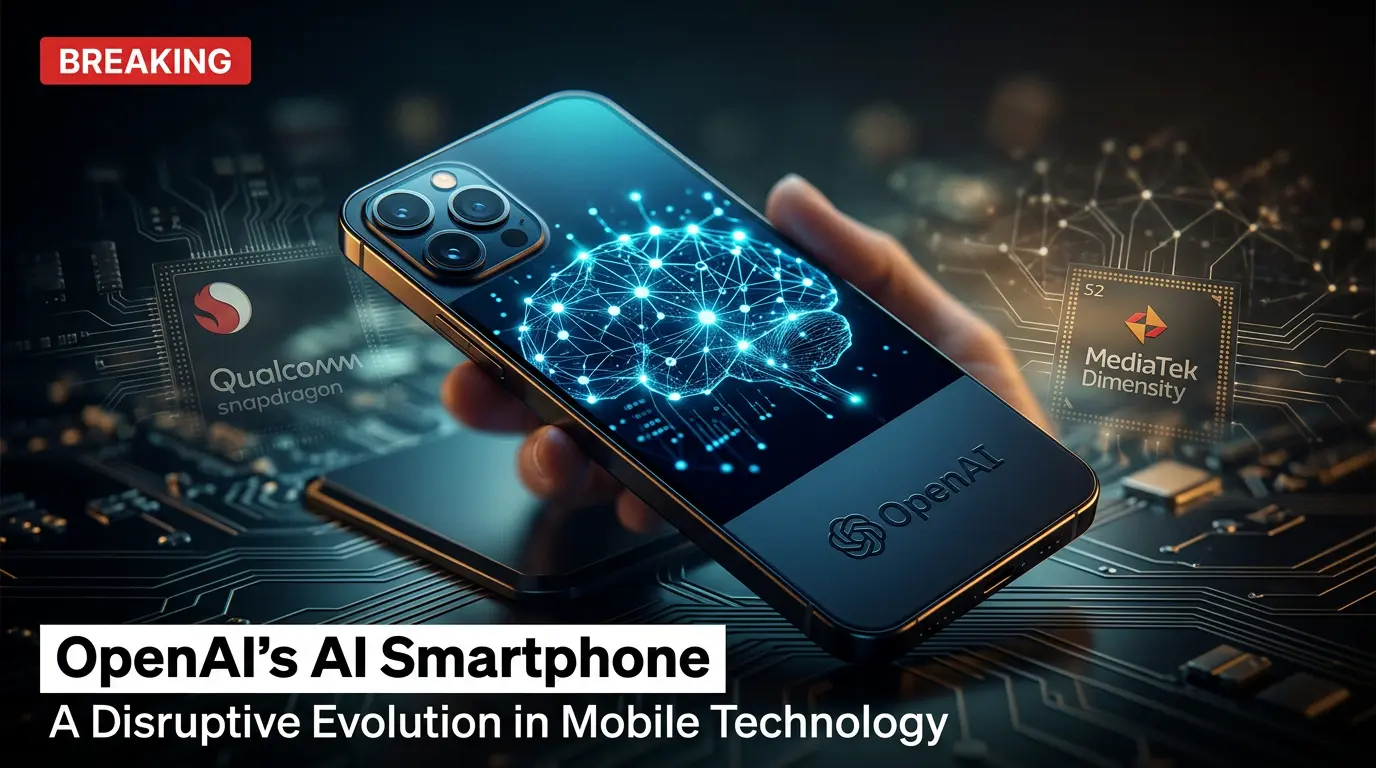
OpenAI’s Bold Gamble: Building the World’s First True AI Smartphone
The ChatGPT maker is quietly laying the groundwork for a hardware revolution — one that could upend Apple, Samsung, and the entire mobile industry.
The smartphone wars have a new contender. OpenAI, best known for powering the world’s most widely used AI assistant, is reportedly in advanced discussions with chip giants Qualcomm and MediaTek to co-develop a custom processor for what insiders are calling an “AI-first” smartphone. If the project succeeds, it won’t just be another phone — it could redefine what a phone is.
The revelation, first surfaced by Apple supply chain oracle Ming-Chi Kuo of TF International Securities on April 26, 2026, sent Qualcomm’s stock soaring over 13% in premarket trading — a rare, electric market reaction that signals just how seriously Wall Street is taking OpenAI’s hardware ambitions.
A Phone Built Around Intelligence, Not Apps
The concept is deceptively simple, yet profoundly disruptive. OpenAI’s vision, according to Kuo’s supply chain findings, is not merely to embed ChatGPT into an existing Android or iOS device. The company wants end-to-end ownership — custom silicon, a tailored operating system, and a hardware form factor — all engineered from the ground up to run AI agents natively and seamlessly.
Think less “ChatGPT on your phone” and more “a phone that is ChatGPT.”
In a world where users are already bypassing traditional apps to get tasks done through conversational AI, OpenAI appears to be betting that the next logical step is eliminating the middleman entirely. No app drawer. No friction. Just intention and execution, powered by persistent, on-device AI agents that understand you deeply — because they’re built into the very chip that runs your device.
The Partnership That Makes It Possible
Pulling off such an audacious project requires formidable partners. OpenAI has reportedly tapped Qualcomm — the reigning king of premium Android mobile processors — and MediaTek, whose aggressive expansion into AI-capable chipsets has made it a dominant force in the mid-to-high-end market. Together, they bring decades of mobile silicon expertise that OpenAI simply doesn’t have in-house.
On the manufacturing side, Luxshare — the Chinese contract manufacturer increasingly trusted for precision electronics assembly — is named as the exclusive system co-design and production partner. The division of labor is clear: OpenAI brings the AI software and product vision; its partners bring the hardware muscle.
Mass production is targeted for 2028, with critical supplier decisions expected to be locked in by late 2026 or early 2027. That timeline suggests OpenAI is not rushing this — they’re building it right.
OpenAI’s Expanding Hardware Ambitions
This smartphone project doesn’t exist in isolation. It’s part of a broader, accelerating push by OpenAI into the physical world. The company has been quietly assembling a hardware strategy that includes a much-anticipated AI wearable device co-developed with Jony Ive, the legendary designer behind the iPhone’s iconic industrial design. In 2025, OpenAI also announced a multi-year chip partnership with Broadcom, signaling that custom silicon is central to its long-term product roadmap.
Sam Altman has long argued that the future of AI isn’t just in the cloud — it’s in the devices people carry, wear, and interact with every moment of their lives. The smartphone project is perhaps the most direct expression of that philosophy.
A Direct Challenge to Apple and Samsung
Make no mistake — if OpenAI ships a commercially viable AI smartphone, it will be a direct shot across the bow at Apple and Samsung, the two companies that have dominated the premium smartphone market for over a decade.
Apple’s advantage has always been its tight integration of hardware and software. OpenAI is now pursuing the same playbook, with one critical differentiator: AI is the operating system, not just a feature bolted on top. Samsung’s Galaxy AI and Apple Intelligence are impressive, but they are still additions to existing paradigms. OpenAI’s device, if realized as envisioned, would represent a paradigm shift.
The global high-end smartphone market represents 300–400 million units annually, and an AI-native device capable of handling scheduling, communication, research, commerce, and productivity through a single intelligent interface could trigger a massive new replacement cycle — the kind the industry hasn’t seen since the original iPhone in 2007.
Caution Warranted — But the Signal Is Clear
It’s important to note that OpenAI, Qualcomm, MediaTek, and Luxshare have all declined to officially confirm the project. Kuo’s track record on supply chain intelligence is strong, but hardware projects of this complexity face enormous execution risk. The gap between a custom chip partnership and a consumer-ready smartphone is vast, and 2028 remains a fluid target.
Yet even as a rumor, the market’s reaction — stocks surging, analysts buzzing, headlines blaring — underscores a fundamental truth: the era of AI-native hardware has arrived, and the companies that define it will shape the next decade of technology.
OpenAI has already changed how we think about software. Now, it’s coming for your pocket.
Reported on April 27, 2026. All details based on supply chain analyst reports by Ming-Chi Kuo / TF International Securities. Official confirmation from parties involved is pending.