


AI Agent vs. Chatbot: Understanding the Core Differences
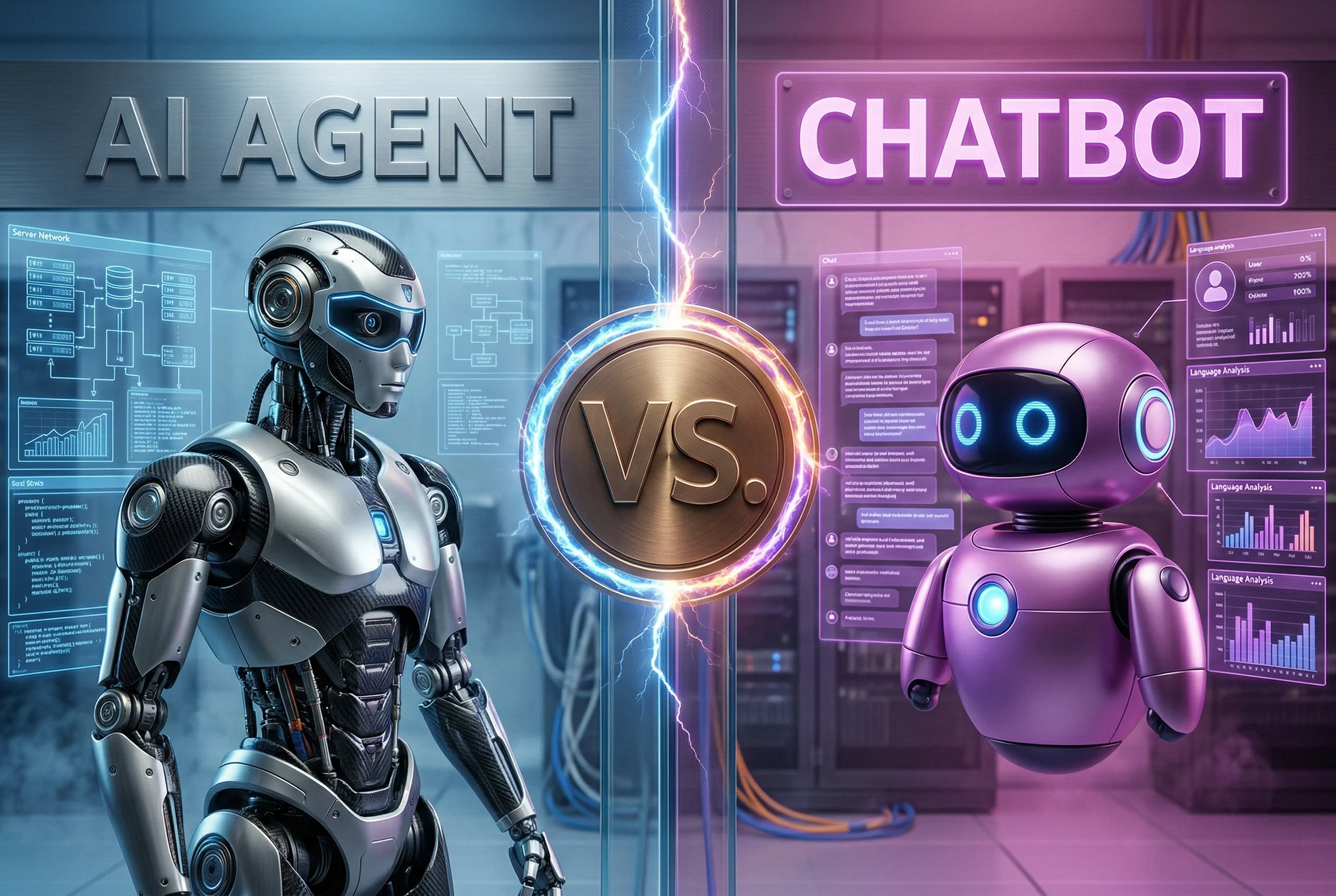
AI is transforming business and daily life, but not all AI systems work the same way. In 2026, organizations must grasp the difference between an AI agent and a chatbot to choose the right tool for each task. Chatbots have long been the public face of conversational AI, handling FAQs and simple support. However, a new generation of autonomous AI agents is emerging – systems that can pursue goals, take independent actions, and even orchestrate multi-step workflows. This blog explains why that distinction matters today. We’ll define each concept, give real-world examples, compare their core capabilities in a table, and discuss how architecture (memory, autonomy, tool use, goal-orientation) shapes their function. We’ll also look at practical use cases in SaaS and enterprise settings, when one can (or can’t) replace the other, and where the AI landscape is headed.
What is a Chatbot?
A chatbot is a conversational AI program designed to simulate dialog with users, typically via text or voice. Traditional chatbots follow pre-defined scripts or rules (decision trees) to answer queries or perform basic tasks. For example, asking Siri or a website bot “What’s the weather?” or “How can I reset my password?” triggers a scripted response. These systems use natural language processing (NLP) but generally have limited understanding. They excel at simple, predictable interactions like answering FAQs or gathering basic information.
However, chatbots are inherently reactive: they wait for user input and then respond. They have minimal contextual memory and little ability to reason beyond their scripts. If a conversation goes off the expected path, a chatbot can easily break or fall back to generic answers. Think of a chatbot like a digital “vending machine” for answers – it has a fixed inventory of responses and only dispenses what’s scripted. This makes chatbots fast and cost-effective for routine questions, but limits them to conversational AI use cases. Common examples include customer service bots on websites, basic helpdesk assistants, or voice assistants that answer a narrow set of queries. In essence, a chatbot is optimized for structured, repetitive dialog rather than open-ended problem-solving.
What is an AI Agent?
An AI agent is a more advanced, autonomous system designed not just to converse but to act on goals. AI agents are often built on large language models (LLMs) or advanced AI architectures, and they can perceive context, reason, plan tasks, and take initiative across multiple software systems. Unlike chatbots, AI agents do not wait for explicit user prompts at every step; they can observe information, make decisions, and pursue objectives with minimal human direction. In practical terms, an AI agent functions like a digital assistant or co-pilot that can coordinate complex workflows. For example, it might triage support tickets, schedule meetings across calendars, or generate reports – all autonomously and end-to-end.
Key characteristics of AI agents include goal-orientation and learning. An AI agent is often goal-driven: it is given an objective (e.g. “Automate new-hire onboarding” or “Resolve this network issue”) and then plans and executes the steps required. It uses AI reasoning (often via LLMs) to interpret intent, and it can use data and tools to carry out tasks. AI agents also learn and adapt over time. They maintain richer memory or state across interactions, allowing personalization and context-awareness beyond a single conversation. In sum, AI agents are a form of “agentic AI” – autonomous systems that can think, learn, and act to solve complex problems.
Real-World Examples
To illustrate the difference, consider some examples of each:
- Chatbot examples: Typical chatbots include customer-service bots on websites or messaging apps (e.g. answering shipping questions or booking confirmations), voice assistants for simple queries (like telling you the weather or setting a timer), or even AI chat interfaces like customer support bots built with rule-based logic. For instance, Siri or Alexa answering “What’s the time?” or an on-site FAQ bot responding with prewritten answers are chatbots in action. Even advanced NLP chatbots like early versions of ChatGPT (without plugins) function primarily as reactive Q&A interfaces.
- AI Agent examples: Modern AI agents are more like digital assistants that execute tasks. For example, Microsoft Copilot (integrated into Office) acts as an AI agent by drafting emails, analyzing spreadsheets, or generating content based on user instructions. In enterprise settings, companies use agents that tie into their data. A Salesforce Einstein agent might auto-summarize last week’s sales data or plan your sales calls by pulling CRM information. Another example is an autonomous IT support agent in Slack or Teams: it could see a user’s “VPN not connecting” request, check device status via company APIs, reset permissions, update the ticket system, and notify the employee — all without manual intervention. In HR, an AI agent might automate onboarding: it reads new-hire data, creates accounts in multiple systems, assigns training modules, and schedules orientation sessions. These agents are proactive and handle multi-step processes across tools.
In short, chatbots are examples of conversational AI – they chat. AI agents are examples of agentic AI – they do work. Both may use similar language models under the hood, but agents are built with autonomy and tool use in mind.
Side-by-Side Comparison of Key Capabilities
The table below compares chatbots and AI agents on key dimensions:
| Capability | Chatbots | AI Agents |
|---|---|---|
| Autonomy | Reactive – waits for user prompts. | Proactive – can initiate actions toward goals. |
| Decision-making | Rules-based or scripted logic. | Contextual and goal-driven reasoning. |
| Task Complexity | Single-step, straightforward tasks. | Multi-step, complex workflows. |
| Memory & Context | Short-term memory (usually per session only). | Rich context – tracks state/history to personalize. |
| Learning & Adaptability | Static; manual updates needed for new info. | Dynamic; uses ML to learn from interactions. |
| Tool & System Integration | Limited integrations (often a single domain). | Deep orchestration across multiple apps/APIs. |
| Personalization | Minimal – same response for all users. | High – tailors results using user and data history. |
| Use Cases | FAQs, basic support, simple routing. | End-to-end task automation, insights, cross-system processes. |
This comparison highlights that chatbots excel at narrow, reactive interactions (good for high-volume Q&A and basic workflows), whereas AI agents handle open-ended, multi-step goals with autonomy and broader integration.
Architectural and Functional Differences
Behind the scenes, several architectural factors distinguish chatbots from AI agents:
- Memory and Context: Chatbots are typically stateless or have only session-limited memory. If a user logs out or changes topic, most chatbots “forget” the prior context. Some modern conversational bots keep a short context window, but they rarely build long-term profiles. By contrast, AI agents are designed with persistent context and memory. They can store user preferences, past interactions, and organizational data. This allows agents to recall past tasks or user details across sessions. For example, an agent might remember that you prefer email reminders, or recall last month’s purchase when processing a return. This rich context makes agents much more personalized and efficient.
- Autonomy and Goals: Chatbots are generally passive. They answer when asked, and they lack internal goals. An AI agent, on the other hand, is goal-oriented. It takes ownership of an objective and figures out how to achieve it. Architects of agentic systems often describe agents as being able to “think and act on their own”. For instance, given the goal “prepare onboarding”, an AI agent might schedule training, request equipment, and send checklists automatically. In practice, this means agents implement a loop of observe–plan–act: they observe environment and data, plan steps toward the goal, then execute actions across tools. This requires advanced planning and reasoning capability absent in basic chatbots.
- Tool Use and Integration: Chatbots typically integrate with one or a few systems via fixed APIs. For example, a helpdesk chatbot might be able to look up order status or log a ticket. However, it rarely controls many applications or updates multiple records in sequence. AI agents are built for deep system orchestration. They can connect to CRM, ERP, email, databases, IoT sensors, and more. An agent can read from a data source, process information, and then perform actions in another system (for example, updating an invoice in the accounting software and then emailing a summary). This multi-app integration is essential for complex, multi-step automation.
- Learning and Adaptability: Traditional chatbots require manual coding or rule updates when business logic changes. To add a new answer, a developer edits the script. AI agents leverage machine learning and reinforcement learning to automatically adapt. They can use feedback to improve their decision-making over time. For instance, if an agent notices a frequent firewall issue in support tickets, it might learn to preemptively apply a fix or draft a KB article. This self-improving behavior reduces maintenance effort. That said, enterprise deployments often still include guardrails and human oversight, given the potential complexity.
- Goal-Orientation: Chatbots do not have long-term objectives. They exist within the single conversation. AI agents, however, are programmed or trained to achieve outcomes. This might involve decomposing a big goal into smaller tasks. Expert analysis notes that chatbots “answer questions and assist”, whereas agents “independently plan, act, and validate results across tools and systems”. This structural difference means agents can keep working on a problem until it’s resolved (or escalated), while chatbots stop at response.
Overall, the architecture of an AI agent is much closer to a human-like assistant that coordinates across domains, whereas a chatbot is a narrow module for conversation.
Practical Applications in SaaS and Enterprise
Both chatbots and AI agents are used in SaaS and enterprise contexts, but they solve different problems:
Chatbot Use Cases: Chatbots are ideal for high-volume, repetitive interactions. Common use cases include:
- Customer Support: Answering FAQs about products, order status, or policies. For example, an e-commerce site might use a chatbot to confirm shipping details or return instructions.
- Service Desk Triage: A corporate IT helpdesk bot that identifies a user’s issue category (password reset, software request) and either provides answers or opens a ticket.
- Lead Capture and FAQs: Marketing chatbots that engage website visitors with templated messages, capture contact info, or give basic product info.
- Knowledge Base Querying: Chatbots that retrieve and surface documentation from a database (e.g. bank account balance retrieval or policy lookup) when questions are straightforward.
- Appointment Scheduling: Bots that handle fixed scheduling tasks, like confirming or canceling appointments via a chat interface.
These use cases share that the conversation flow is predictable and does not require cross-system actions. Chatbots work well here because they deliver consistent answers fast and at scale. They require relatively low compute and can be implemented quickly for well-defined tasks.
AI Agent Use Cases: AI agents shine in automating end-to-end workflows and complex processes. Examples include:
- Automated HR and Onboarding: An AI agent reads new-hire data (from HR systems), creates user accounts in IT systems, orders hardware, schedules training, and sends orientation emails – with minimal human steps.
- IT and Operations (AIOps): Agents that detect network issues, create support tickets, apply fixes, and notify teams automatically. For instance, an agent could proactively resolve a server outage or help a user regain access to an application.
- Sales and CRM Automation: Personal AI agents that pull CRM data to prioritize leads, craft outreach emails, or summarize customer meetings in context.
- Finance and Accounting: Agents to automate invoice processing, expense approvals, or financial report generation. For example, an agent might match invoices to purchase orders, approve payments (within set rules), and update the accounting system.
- Customer Success and Support: AI agents that don’t just answer a ticket, but resolve it. They can fetch relevant knowledge from past tickets, interact with multiple tools (CRM, email, chat), and follow up automatically with customers when issues are resolved.
- Marketing and Personalization: Systems that analyze user data and then create custom content or campaigns. E.g., an agent that draws on customer purchase history to tailor marketing emails and schedules them via marketing automation tools.
In SaaS products, this often translates to agentic features like “smart assistants” embedded in platforms (for example, smart scheduling in project management tools, or proactive recommendations in CRMs). Enterprises use AI agents to tie together disparate systems. As Gartner predicts, by 2026 many business applications will include task-specific agents. In short, when a process spans multiple steps or systems and demands judgment, an AI agent is usually the better fit.
Can AI Agents Replace Chatbots?
A common question is whether AI agents will make chatbots obsolete. The answer is nuanced. Chatbots are not disappearing overnight – they remain practical for simple tasks where an agent’s full capability isn’t needed or affordable. In fact, industry experts note that agents and chatbots are different levels of capability rather than directly competing technologies.
In practice, hybrid approaches are common. Many organizations use chatbots for low-risk, high-volume queries (e.g. answering routine FAQs) and reserve AI agents for complex workflows. If a chatbot frequently has to escalate cases to humans or fails to resolve issues, that’s a signal to adopt an agentic solution.
Research echoes this: “Chatbots are better for simple conversations and FAQs, while AI agents are built for full resolution of complex tasks”. Aisera predicts that while the industry is moving toward agentic systems, chatbots will still be used as cost-effective point solutions for basic needs. Gartner’s forecast says 40% of enterprise apps will use AI agents by 2026, but it implies the other 60% (for straightforward use cases) may still rely on chatbots or manual processes.
Ultimately, one won’t completely replace the other soon. The key is to evaluate each task on complexity and value. Use chatbots for high-volume, predictable interactions, and deploy AI agents when you need multi-step automation and personalization.
Future Outlook: The Evolving AI Landscape
Looking ahead, both conversational and agentic AI are set to advance. Chatbots and conversational AI will get smarter: better natural language understanding, improved multi-turn dialogue, and more seamless multi-modal interactions (text, voice, images). Meanwhile, autonomous AI agents are likely to become more sophisticated and specialized. By 2026, analysts expect agentic AI to transition from experimental to mainstream in many businesses. We may see agents collaborating as “digital workforces,” handling tasks like invoice reconciliation or alert triage with minimal human oversight.
The growth of large language models and integrated APIs will fuel this trend. For example, increasingly powerful LLMs (GPT-4/5, Gemini, etc.) can provide the “reasoning” core of agents, while APIs give them reach into enterprise systems. However, with great autonomy comes the need for control. Experts emphasize governance: audit trails, human-in-the-loop options, and strict security for agent actions. This is especially crucial as a survey found that many companies view autonomous agents as both a major opportunity and a security risk.
Geographically, SaaS vendors worldwide are adding AI agent capabilities. Companies in every region are building AI copilots and automated assistants for local enterprises. The term agentic AI is becoming mainstream in tech strategy. We can expect more pre-built AI agent services (like vendor offerings in IT service management, HR, finance) and more open-source agent frameworks.
In summary: The AI agent vs chatbot distinction will remain important. In 2026 and beyond, success will go to organizations that match the tool to the task. Chatbots will handle the voice of “conversational AI” – easy Q&A and stable tasks – while agentic AI takes on the heavy lifting of cross-system automation. As we move from merely chatting with machines to having them autonomously work on our behalf, the era of outcome-driven AI agents is well underway.
Frequently Asked Questions
What is the core difference between an AI agent and a chatbot?
A chatbot follows scripted flows to answer questions, whereas an AI agent uses reasoning and integrations to autonomously achieve multi-step goals.
What are some chatbot use cases?
Chatbots are ideal for handling simple, repetitive tasks and FAQs – e.g. answering customer support questions, conducting basic surveys, routing inquiries, or confirming appointments.
Can a chatbot be upgraded into an AI agent?
Not easily. They have fundamentally different architectures. Moving from a chatbot to an agent usually means building or leveraging a new agent-based framework with autonomy and learning built in.
Are AI agents safe for businesses to use?
AI agents can be safe if properly governed. Companies implement guardrails, permission controls, and human oversight to ensure agents follow policies and handle data responsibly.
How do AI agents and chatbots improve operations?
Both save time and reduce costs by automating tasks 24/7. Chatbots improve efficiency for routine inquiries, while AI agents deliver greater gains by automating end-to-end processes and delivering personalized outcomes.